Blowback
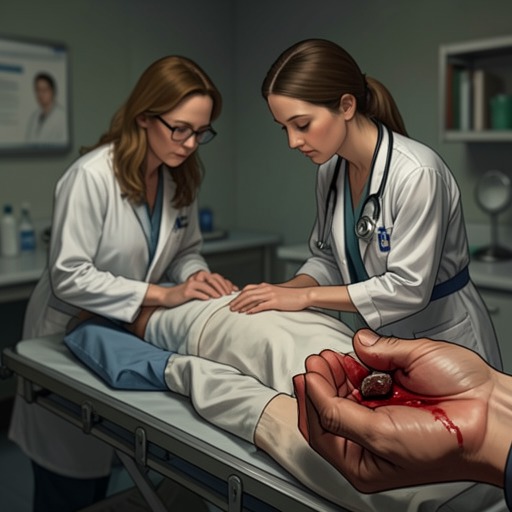
Night TrainBlowback is the name given to microscopic blood and tissue particles found on Jennifer Rockwell’s right hand and forearm. In the account of her death, the term marks a shift from watching an examination to interpreting evidence: the particles are considered alongside the position and condition of Jennifer’s hand, and the narrator arrives at the conclusion that she killed herself. The concept’s significance lies not in one trace by itself, but in the way several physical observations are assembled into a finding.
Definition and Forensic Role
Blowback is presented as a specific kind of trace evidence: microscopic particles recovered from the right hand and forearm. The narration names the material and its location, making the finding concrete without claiming that the particles alone settle the question of how Jennifer died. Its force emerges through association with other observations about the same hand.
That sequence matters. The examination moves from a small, nearly invisible residue to a bodily condition and then to marks associated with the weapon. These details form a cumulative argument. Rather than treating a single clue as self-explanatory, the account places different kinds of evidence beside one another and gives their relationship interpretive weight.
Findings Associated with the Hand
The account also reports cadaveric spasm in Jennifer’s right hand, described as spontaneous and temporary rigor mortis. It further notes that the curve of the trigger and the pattern of the weapon’s butt were impressed in her hand, indicating how tightly she had gripped it. These observations are distinct from blowback: one concerns particles on the hand and forearm, another a temporary physical state, and another the pressure and contact associated with the grip.
Taken together, the findings connect Jennifer’s hand to the weapon and to the death under examination. The narration does not reduce that connection to an abstract label; it identifies the side of the body, the areas where particles were found, and the particular features of the weapon reflected in the hand. This physical specificity gives the later conclusion a stated evidentiary basis while leaving the findings themselves distinguishable from the interpretation made from them.
From Examination to Conclusion
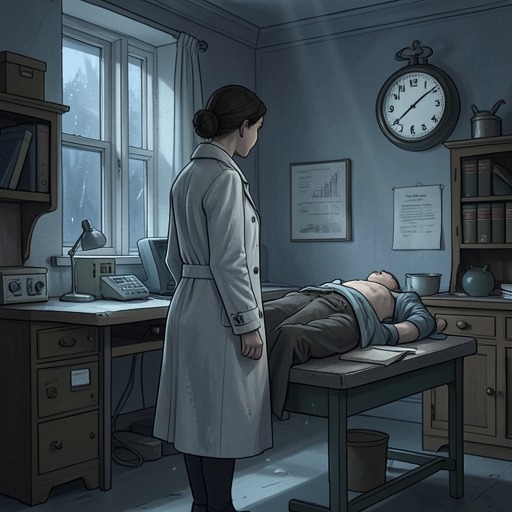
The account first presents an examination in progress. The narrator describes the procedure, then registers a bodily response to witnessing it. At this point, what is being seen has not yet resolved into a clear meaning for the narrator. A further moment follows in which Paulie No points something out and Tony Silvera leans forward; both men then move back in surprise. The passage records the reaction without making the object of the pointing explicit, preserving a measure of uncertainty around what has just been noticed.
The initial impression is that Jennifer Rockwell shot herself in the head three times. Later, the discussion of blowback and the other findings concerning her hand leads to a direct conclusion: Jennifer killed herself. The distinction between these moments is important. The earlier account registers what the examination appears to show; the later account sets out forensic observations and states what the narrator takes them to establish. Blowback belongs to this movement from unsettled perception toward a conclusion, not to a claim that one particle finding independently explains every aspect of the death.
Narrative Significance
The presentation turns forensic description into an act of recognition. The particles are microscopic, but their meaning depends on where they were found and how they relate to the other evidence. The hand, in turn, is not merely a site recorded during examination: its condition and impressions help connect Jennifer to the weapon. The account therefore makes the body the ground on which observation and inference meet.
That meeting does not erase the narrator’s earlier uncertainty. While watching the examination, the narrator hears Colonel Tom’s position but remains unsure how much the observation means. The later findings supply a more definite basis for judgment, and the conclusion is stated plainly. The sequence preserves a distinction between witnessing evidence and understanding it: seeing begins the process, but interpretation requires the findings to be brought into relation.
Blowback consequently functions both as a forensic term and as a hinge in the account. It names a material trace, then participates in a larger evidentiary chain involving Jennifer’s right hand, the reported cadaveric spasm, and the impressions of the trigger and butt. Its narrative importance comes from this accumulation: separate observations make a conclusion possible, while the progression from initial uncertainty to a stated finding keeps the act of interpretation visible.